
Every admission season, I meet parents who carry a quiet worry. They have driven past gleaming campuses with “international†in their names, seen the glass facades and the fee brochures — and they ask me, almost apologetically: “Is our Indian education enough? Will my child be left behind?â€
It is an honest question and it deserves an honest answer. So, let us ask, without defensiveness and without awe: what does “international†really mean and what does a child truly need to stand confidently in the world?
The word is used in two very different ways. In its precise sense, an international school follows an international board such as the International Baccalaureate (IB) or Cambridge — authorised by that board, with its teachers trained in its methods. In its looser sense, “international†is simply part of a name, chosen for how it sounds.
The word in a school's name does not, by itself, tell you which board it follows or how it teaches. So the first question for any school is a simple one: Which board are you affiliated to and may I see the proof?
Is Indian Education Inferior, Outdated or Only Rote?
Let us be truthful. Rote learning has been a real weakness in many Indian classrooms & the culture of marks & coaching has too often crowded out curiosity. Any educator who denies this is not serving parents well.
But to call Indian education outdated is to look at a photograph that is many years old. The National Education Policy 2020 asks schools to move from memorisation to understanding, from silos to connections, from a single exam to continuous growth. CBSE has followed through: about half the marks in its board papers now come from competency-based questions — case studies, source-based and application questions that cannot be answered by memory alone. From 2026, Class 10 students can also sit the board examination twice in a year.
And we should not forget whose tradition this is. Nalanda and Takshashila drew scholars across continents, centuries before the word “international†entered our prospectuses. Debate, inquiry and the dialogue between teacher and student — the very methods now celebrated as modern pedagogy — have deep roots in our own soil.
“The question is not whether a curriculum is Indian or international. It is whether the classroom is alive.â€
Do Higher Fees Mean Better Education?
Fees reflect many things: land and buildings, international board charges, smaller classes, imported materials, sometimes simply the market. Some of these genuinely benefit children. Others do not reach the classroom at all.
A wiser question than “How much does it cost?†is “Where does the money go?†How much is invested in teachers — their salaries, their training, how long they stay? A school's quality is decided less by its fee than by the stability and growth of the people who teach.
Does Glass and Steel Bring Modernity?
Modernity is not an architectural style. It is a way of thinking. A child dictated notes in an air-conditioned, glass-walled room is having an old experience in a new building. A child who questions, experiments and argues respectfully under a neem tree is having a modern one.
Good infrastructure matters — safe, clean, well-lit spaces, working laboratories, a living library, room to play. But when you visit a campus, look past the facade. Watch a lesson. Count how many questions come from the children.
Who Will Actually Teach My Child?
A curriculum is only as good as the teacher who brings it to life. An international curriculum in the hands of a teacher who has not been trained in it, or who leaves after a year, is a brochure — not an education.
International boards such as the IB expect teachers to complete the board's own professional training. So, ask any school: How many of your teachers are trained in the curriculum you offer? How long do they stay? How do they adapt it to children who think, dream and speak at home in Tamil, Telugu, Malayalam or Hindi?
Equally, an Indian teacher who understands a child's language, family and world — and who keeps learning — can open that child to the whole world. Exposure can be built through training, exchange and reading. Understanding a child cannot be imported.
Is It About a “Better†Peer Group?
Connections matter — perhaps more today than ever. But the strongest network a child can build is made of people who think clearly, speak confidently and work well with anyone. That comes from a school’s culture — not its fee. So don’t take any school’s word for its peer group, including ours. Ask to meet the senior students and listen.
What Global Readiness Really Requires
When I think of the young people from Indian classrooms who have gone on to study and lead across the world, what carried them was rarely the label on their school. It was a set of qualities any good school can nurture:
- Clear thinking: the habit of asking why, and the courage to disagree respectfully.
- Communication: fluent, confident English alongside pride in their mother tongue.
- Collaboration: working with people unlike themselves.
- Digital and scientific fluency: using technology to create not only to consume.
- Character and rootedness: knowing who they are and where they come from.
- Empathy and service: caring about the world they hope to change.
Roots and wings — a child needs both and neither has to be imported.
Questions to Ask Any School
- Which board are you affiliated to and for which grades?
- How many teachers are trained in this curriculum, and how long do they stay?
- May I observe a class?
- How are children assessed — memory, or understanding and application?
- What real international exposure do students get — exchanges, competitions, collaborations?
- How does the school keep children connected to their language, culture and values?
- Where does the fee go?
International in Outlook, Indian at Heart
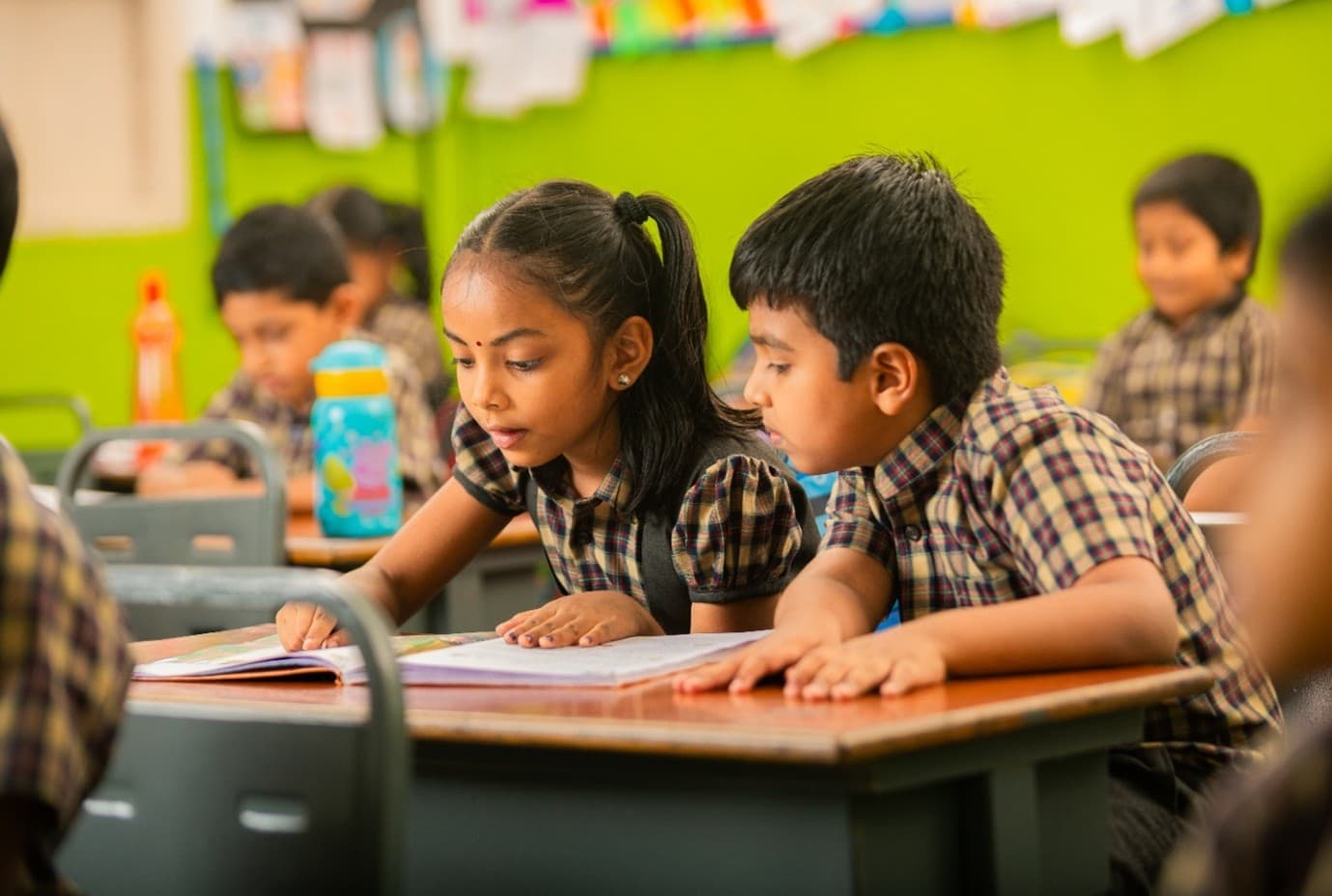
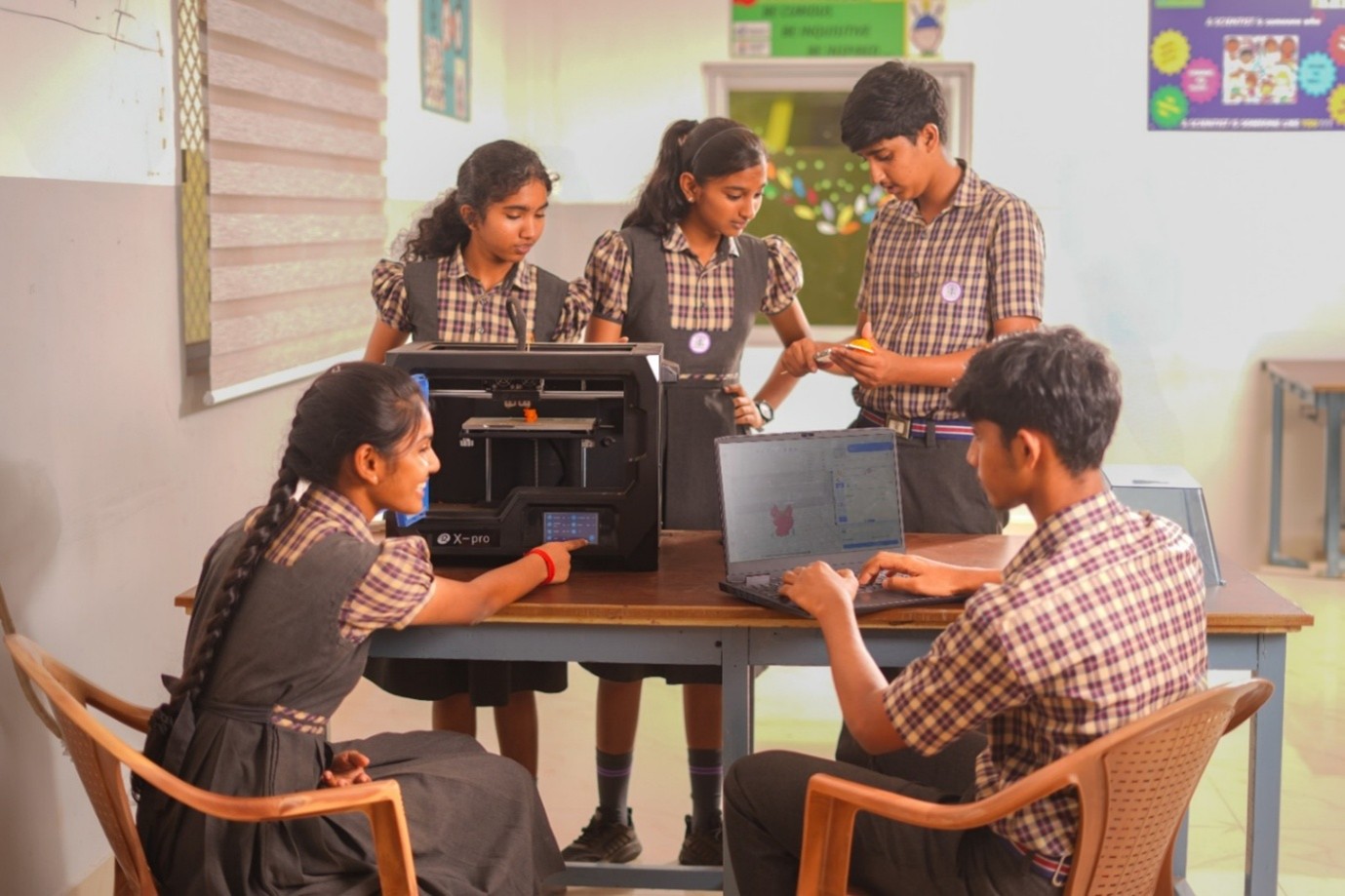
At SJSV, we have never seen a contradiction between the two. Our students debate global questions at IIMUN, build robots in our Makers Lab, and work on STEM projects with partner teams in Texas and New Jersey — while celebrating our arts at Kalanjali and learning to care for Singanallur Lake. Our CBSE classrooms follow NEP 2020's shift to competency-based learning and our Centrado STEAM curriculum brings robotics, AI and design thinking from Grade 1.
We invite you to visit, sit in a class, speak to our teachers, and judge for yourself. Book a campus visit or call +91 422 259 1460 | +91 9790667890 | +91 9789486868